

If you’ve owned (or toured) a Calgary home built in the late 1980s through the 1990s, there’s a decent chance you’ve heard the phrase Poly B plumbing whispered like a minor curse. And while not every home has it (and not every Poly B system fails immediately), it is something worth checking sooner rather than later.
Here’s the good news: you don’t need X-ray vision to figure out whether your home has Poly B. With a few simple checks, you can often confirm it in minutes. And if you do have it, you’ve got clear next steps – ranging from monitoring to planning a full replacement. In many homes, Poly B plumbing Calgary systems are easiest to identify by looking for grey plastic water lines (sometimes black, blue, or white) that are stamped with “PB” or “Polybutylene,” typically near your hot water tank, in the mechanical room, under sinks, or behind access panels. But let’s break it down properly.
What is Poly B plumbing?
Poly B (polybutylene) is a type of flexible plastic piping that was widely used for residential water supply lines for a period of time because it was:
- cheaper than copper.
- fast to install.
- flexible (fewer fittings, quicker routing).
On paper, it sounded great. In real life, many Poly B systems proved more vulnerable to issues over time, especially at connections and fittings. That’s why homeowners, buyers, and insurers often treat it as a “check this now” item – particularly in markets like Calgary, where winter conditions can strain plumbing systems.
Why Poly B is a concern in Calgary homes
Poly B isn’t automatically a crisis. But it can be a risk, for a few common reasons:
- Age + normal wear catches up: Most Poly B installations are decades old now. Materials that were “fine” at year 10 can behave very differently at year 25+.
- Leaks often happen at fittings: A lot of Poly B issues show up at joints, fittings, and connections – places you can’t always see unless you know where to look.
- Leaks can be “quiet” until they aren’t: Some plumbing problems announce themselves loudly. Poly B leaks can start small behind walls or ceilings and only become obvious once there’s already damage.
If you’re in a Calgary home built in the 1980s or 1990s, checking for Poly B is basically the plumbing version of checking your smoke alarms: not glamorous, but very smart.
Poly B plumbing in Calgary: How to tell if you have it
You can often confirm Poly B with a quick home walkthrough (no tools required). Here are the best places to check.
Look near your hot water tank
Start in your mechanical room or utility area. Check the water lines connected to the hot water tanks.
What Poly B often looks like:
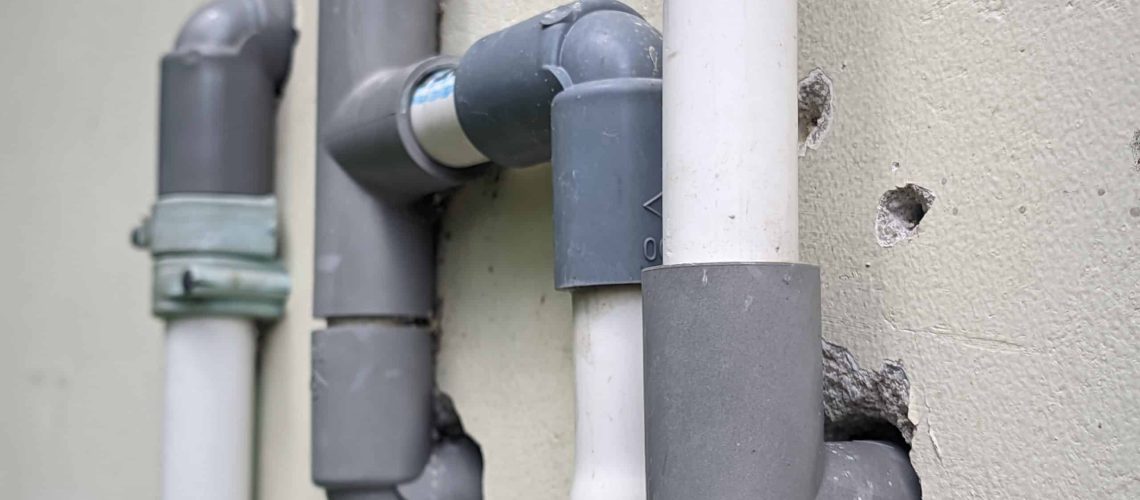
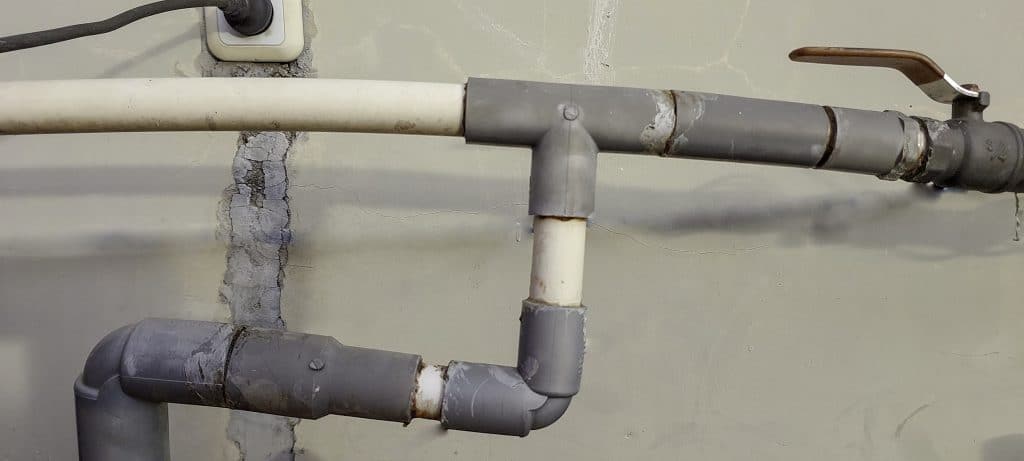
- grey plastic pipe (most common).
- sometimes black, blue, or white.
- flexible, slightly “waxy” appearance compared to other plastics
What to look for on the print/markings:
- “PB”.
- “Polybutylene”.
- “PB2110” (a common stamp on Poly B piping).
If you see a grey plastic line and it’s stamped PB/PB2110, that’s a strong indicator you’ve got Poly B supply lines.
Check under sinks and vanities
Open the cabinet doors in kitchens and bathrooms. Look behind the P-trap (the curved drain pipe) and focus on the water supply lines, not the drain.
Poly B supply lines may run up through the floor or back wall, then connect to shutoff valves.
Look behind access panels
If your home has an access panel near a bathtub or shower (often a plain removable panel), pop it open and look for the supply lines feeding the fixtures.
Inspect the basement ceiling (if unfinished)
In unfinished basements, water lines are sometimes visible running along joists. If you see grey flexible piping feeding upstairs fixtures, that’s another clue.
Compare it to PEX (common mix-up)
Many homeowners confuse Poly B with PEX – another flexible plastic pipe widely used today.
Quick visual differences (general rule of thumb):
- PEX is often red/blue/white and typically looks “newer,” with modern brass or polymer fittings.
- Poly B is most often grey, and older installations may have specific PB markings and older-style fittings.
If you’re unsure, a plumber can confirm it quickly – especially if markings are hard to read.
What to do if you find Poly B plumbing
So you’ve spotted grey PB lines. Now what?
Step 1: Don’t panic – check for symptoms
Poly B doesn’t mean your home is actively leaking today. First, look for signs that suggest a problem may already be developing:
- unexplained water spots on ceilings/walls.
- damp drywall, bubbling paint, or musty smells.
- sudden drops in water pressure.
- frequent plumbing “mysteries” (random wet patches, recurring moisture).
- evidence of previous patch repairs.
If any of these are present, it’s worth moving quickly.
Step 2: Book a proper inspection (targeted, not guesswork)
A professional plumbing inspection for Poly B typically focuses on:
- identifying where Poly B exists (whole home vs partial).
- checking visible connections and fittings.
- looking for signs of past leaks or stress points.
- discussing replacement options and the access required.
This gives you a real plan, not a vague “we should probably do something” feeling.
Step 3: Decide between monitoring vs replacing
Your best move usually depends on:
- how much Poly B is present (a short section vs whole-home).
- whether there’s any existing leakage or past water damage.
- how accessible your plumbing runs are.
- your future plans (selling soon vs staying long-term).
- your insurance requirements.
In many cases, full replacement is the long-term solution, especially if Poly B runs throughout the home.
Is Poly B replacement always necessary?
Not always immediately – but it’s often recommended sooner rather than later, mainly because the downside risk can be expensive.
Here’s a practical way to think about it:
You might monitor for now if…
- Poly B is limited to a small area.
- your home has easy access and you’re already planning renovations.
- there are no signs of leaks or previous repairs.
- your insurer is fine with it (this varies).
Monitoring still means keeping an eye on areas where leaks would show up and planning replacements before they become urgent.
You should seriously consider replacement if…
- Poly B is throughout the home.
- there have been past leaks or patch repairs.
- you’re finishing a basement (best time to replace before drywall goes up).
- you’re buying/selling and want fewer surprises.
- insurance is raising questions or limiting coverage.
What does Poly B replacement involve?
A whole-home Poly B replacement in Calgary means removing or abandoning Poly B supply lines and replacing them with a modern, approved piping material (commonly PEX, depending on the home and the plumber’s approach).
What homeowners usually want to know
Q: Will you have to open walls?
A: Sometimes, yes. The goal is to route new lines efficiently while minimizing drywall disruption. Access depends on your home layout, finished spaces, and where the lines run.
Q: How long does it take?
A: That depends on the home size, number of bathrooms, and how accessible the plumbing is. Many projects can be completed efficiently, but the exact timing is case-by-case.
Q: Do you replace everything at once?
A: Often, yes – because partial replacement can leave you with remaining risk in other areas. That said, some homeowners phase it during renovations. A plumber can advise what’s sensible.
Q: Will my water be off?
A: Typically, yes, during portions of the work. A good plan minimizes downtime and keeps disruption manageable.
Common mistakes Calgary homeowners make with Poly B
Avoiding these can save you money (and stress).
Assuming “no leaks yet” means “no risk”: It might just mean you haven’t seen it yet. Many leaks start in hidden spots.
Doing patch repairs repeatedly: If a system is failing at multiple points, repeated patching can become a slow, expensive loop.
Waiting until after finishing a basement: Once everything is drywalled and painted, access becomes harder (and more costly). If you’re planning basement development, check plumbing first.
Not asking your insurer early: Insurance rules and underwriting preferences can vary. If you’re planning to buy a home, renew insurance, or sell, it’s worth understanding the expectations before you’re on a deadline.
Buying or selling a home with Poly B in Calgary
If you’re buying:
- Ask the seller what type of plumbing supply lines the home has.
- Check visible piping near the hot water tank and under sinks.
- Consider adding a plumbing inspection condition if you suspect a Poly B issue.
- If you love the house, don’t automatically walk away – just price the risk properly and plan next steps.
If you’re selling:
- Knowing whether you have Poly B lets you control the story.
- Replacing Poly B can reduce buyer objections and inspection friction.
- Even if you don’t replace it pre-sale, being transparent helps avoid last-minute renegotiations.
When to call a plumber
Some checks are homeowner-friendly, but you should bring in a pro if:
- you’ve confirmed Poly B and want a replacement plan.
- you’ve found moisture, staining, or evidence of a leak.
- you can’t tell if it’s Poly B or another material.
- you’re renovating and want to update plumbing while the walls are open.
- you’re buying/selling and need clarity fast.
A quick professional confirmation can save you from guessing – and guessing gets expensive when water’s involved.
What TipTop can do for you if you suspect Poly B
If you think you have Poly B, your next best move is simple:
- Confirm it (quick visual ID + professional verification if needed).
- Assess risk (how much is present, where it runs, any symptoms).
- Plan replacement (ideally before an emergency forces you to change the schedule).
If you’re in Calgary and want help identifying or replacing Poly B, TipTop can inspect your system, explain your options clearly, and lay out a plan that fits your home and timeline.